

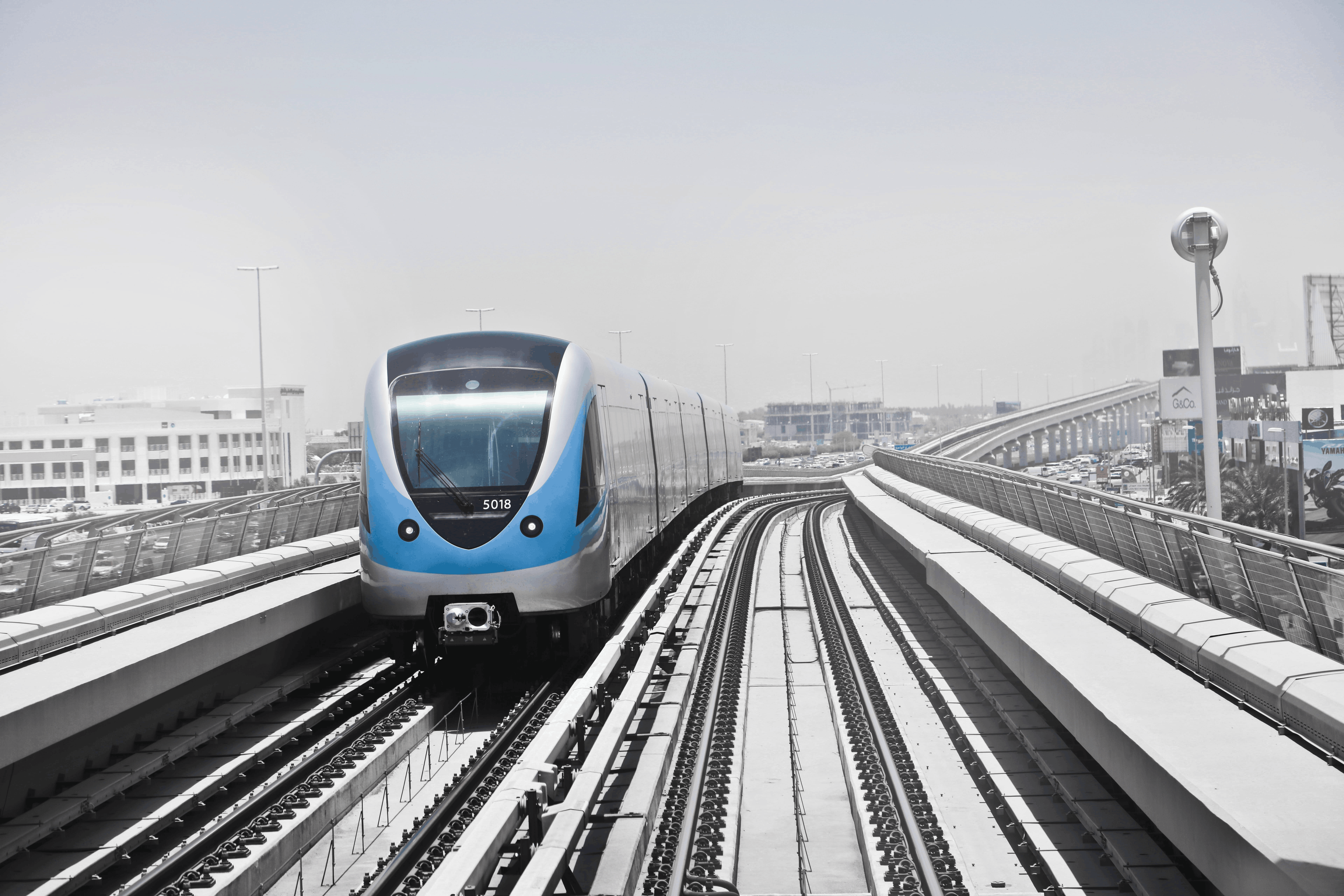
Mumbai Ahmedabad High Speed Rail Corridor
Table of Contents
- Loading contents...
Project at a Glance | |
Project Name | Mumbai Ahmedabad High Speed Rail Corridor |
Alternate Name | MAHSR Project |
Project Sector | Infrastructure |
Project Status | Under Construction |
Project Cost | INR 1,08,000 crore (USD 17 billion) |
Project Start Date | September 2017 |
Project Completion Date | 2029 (Expected) |
Corridor Length | 508 km |
Project Developer | National High-Speed Rail Corporation Limited (NHSRCL) |
Total Stations | 12 |
Starting Point | Bandra Kurla Complex (BKC) |
Ending Point | Sabarmati |
Project Overview
The proposed Mumbai-Ahmedabad High-Speed Rail Corridor project is a 508 km railway line under construction with technical and financial assistance from the Government of India. Also known as the MAHSR project, it is India’s first Bullet Train Project, connecting the states of Maharashtra & Gujarat in Western India.
Starting from the Bandra Kurla Complex (BKC) area in Maharashtra, it ends at Sabarmati Station in Gujarat. Running at an operating speed of 320km/h, the route covers 12 stations, including Thane, Virar, Boisar, Vapi, and Bilimora. Furthermore, it connects to the Union Territory of Dadra & Nagar Haveli.
Developed by the National High-Speed Rail Corporation Limited (NHSRCL), the corridor incorporates the economies of Mumbai, Vapi, Surat, Anand, Vadodara & Ahmedabad. Upon full completion, the travel time be reduced to 2 hours and 7 minutes with limited stops at Surat, Vadodara, and Ahmedabad.
Project Background
On 12 February 2016, the National High-Speed Rail Corporation Limited (NHSRCL) was merged under the Companies Act, 2013, to finance, construct, maintain, and manage the High Speed Rail Corridor in India. With equity participation from the Central Government through the Ministry of Railways (50% share) and from the State Governments of Gujarat (25% share) and Maharashtra (25% share), the company is structured as a 'Special Purpose Vehicle'.
The project is aligned with the PM GatiShakti initiative to transform India’s infrastructure and connectivity and build a Viksit Bharat, Saksham Bharat, and Sashakt Bharat. The delay in land acquisition in Maharashtra impacted the project till 2021. Later, the acquisition process picked up in 2022.
Mumbai Ahmedabad High Speed Rail Corridor Completion Date
The Mumbai Ahmedabad High Speed Rail Corridor is expected to be fully operational by December 2029. This under-construction project has reached 55% physical progress, with land acquisition completed as of early 2026.
Mumbai Ahmedabad High Speed Rail Corridor Cost
The total estimated cost for the construction of the Mumbai Ahmedabad High Speed Rail Corridor is INR 1,08,000 crore (USD 17 billion), excluding taxes. The majority (approximately 81%) of the project's total cost is funded by the Government of Japan through the Japan International Cooperation Agency (JICA). The remaining portion is being funded by the Government of India.
The majority of approved funding for the Mumbai Ahmedabad Rail Corridor comes from the Japan International Cooperation Agency (JICA) through an Official Development Assistance (ODA) loan. The tenure period is 50 years, with a 15-year moratorium.
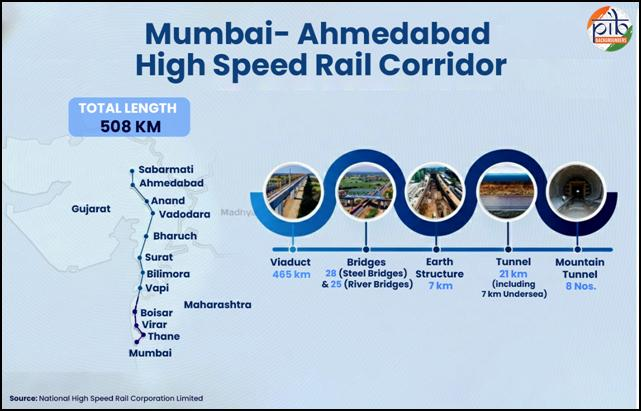
Mumbai Ahmedabad High Speed Rail Corridor Route Map
40+ reviews
Find the Latest Railway Infrastructure Projects In India
Gain exclusive access to our industry-leading database of infrastructure opportunities with detailed project timelines and stakeholder information.
Collect Your Free Leads Here!
No credit cardUp-to-date coverage
Joined by 750+ industry professionals last month
Mumbai Ahmedabad High Speed Rail Corridor Route
The Mumbai Ahmedabad High Speed Rail Corridor begins from the underground Bandra Kurla Complex (BKC) station in Mumbai. It terminates at Sabarmati in Ahmedabad. The 508 km-long rail corridor is divided into sections: underground, tunnel (21 km), viaduct (465 km), and bridge (28 Steel & 25 River Bridges).
The route connects Maharashtra (135 km), Dadra & Nagar Haveli (18 km), and Gujarat (355 km), covering 12 stations in total. It will provide high-speed rail connectivity to the industrial towns of Boisar, Bharuch, and Ankleshwar, as well as to the upcoming Vadhvan Port (via Boisar Station).
Mumbai Ahmedabad High Speed Rail Corridor Station List
Stations | State |
Mumbai | Maharashtra |
Thane | Maharashtra |
Virar | Maharashtra |
Boisar | Maharashtra |
Vapi | Gujarat |
Bilimora | Gujarat |
Surat | Gujarat |
Bharuch | Gujarat |
Vadodara | Gujarat |
Anand | Gujarat |
Ahmedabad | Gujarat |
Sabarmati | Gujarat |
Infrastructure Features at the MAHSR Corridor Project
The MAHSR project features 28 steel bridges ranging from 60 m simple designs to 130 m + 100 m continuous spans. These are made up of approximately 70,000 tonnes of durable steel.
It passes through National & State Highways, Irrigation Canals, Rivers, and Railway Tracks, ensuring smooth travel without interruption.
Furthermore, 25 bridges are being constructed on rivers as part of the alignment. Of these, 21 bridges are constructed in Gujarat and 4 in Maharashtra.
The rail corridor comprises 8 mountain tunnels, built using the New Austrian Tunneling Method (NATM). Of these, 7 tunnels are constructed in Palghar, Maharashtra, and 1 in Valsad, Gujarat.
The alignment features a 21 km long tunnel, including India’s first 7 km undersea tunnel within Thane Creek. A combination of two tunneling methods will be used to construct this tunnel. It includes the New Austrian Tunneling Method (NATM) for 5 km and Tunnel Boring Machines (TBMs) for the remaining 16 km.
Both tracks will be connected to the tunnels via a single 13.1 m-diameter tube. A cutter head with a diameter of 13.6 m is used in Tunnel Boring Machines.
The areas along the route are planned for development under Transit-Oriented Development (TOD) policies. It improves access and convenience for travellers and promotes economic activities in the state.
Project Timeline
Year | Event |
2029 | Full completion of the project (expected) |
January 2026 | Out of 17 steel bridges, 13 steel bridges were completed in Gujarat |
February 2025 | NHSRCL launched 100 meter ‘Make in India’ steel bridge over four railway tracks in Surat. |
October 2023 | First mountain tunnel breakthrough. |
2022 | The land acquisition process gained momentum. |
2021 | The delay in land acquisition in Maharashtra impacted the project |
September 2017 | The foundation stone was laid by PM Modi & Shinzo Abe in Ahmedabad. |
12 February 2016 | National High-Speed Rail Corporation Limited (NHSRCL) was merged under the Companies Act, 2013 |
December 2015 | Agreement signed between India and Japan during PM Modi's visit. |
Project Scope
The following is the project scope of this Bullet Train Project:
Operational Speed: The Mumbai Ahmedabad Rail Corridor is a fully elevated double-track corridor at an operational speed of 320 km/hr. The maximum speed is 350 km/hr.
Multi-modal integration hubs: The track comprises multi-modal integration hubs at major stations for seamless connectivity to Metros, Buses, & Airports.
Technical Specification: The project uses the Japanese Shinkansen bullet train technology, along with advanced earthquake-resistant viaducts and ballastless tracks.
Infrastructure features: The MAHSR project comprises 465 km of viaducts, 28 steel bridges, 25 river bridges, an approximately 7 km-long earth structure, a 21 km-long tunnel, and 8 mountain tunnels.
Paving the way for future corridors: The project is part of India’s National High-Speed Rail Grid, which will pave the way for future corridors such as the Delhi-Mumbai and Mumbai-Chennai Rail Corridors.
Freight Corridors: To improve logistics efficiency, MAHSR includes dedicated freight corridors and enhancements to last-mile connectivity.
Mumbai Ahmedabad High Speed Rail Corridor Ticket Price Details
According to Railway Minister Ashwini Vaishnaw, ticket prices for the Mumbai-Ahmedabad rail corridor will be competitive with existing rail and air travel options. It was announced in the Lok Sabha Statement on 11 February 2026.
40+ reviews
Find the Latest Railway Infrastructure Projects in India
Gain exclusive access to our industry-leading database of infrastructure opportunities with detailed project timelines and stakeholder information.
Collect Your Free Leads Here!
No credit cardUp-to-date coverage
Joined by 750+ industry professionals last month
Mumbai Ahmedabad High Speed Rail Corridor Contractors
Packages | Sections | Contractors |
C1 | Underground station at BKC | Megha Engineering (MEIL) & Hindustan Construction CO. |
C2 | Underground tunnel BKC-Shilphata | Afcons Infrastructure |
C3 | Viaduct Shilphata-Zaroli | Larsen & Toubro (L&T) |
C4 | Viaduct Zaroli-Vadodara | Larsen & Toubro (L&T) |
C5 | Viaduct & Station at Vadodara | Larsen & Toubro (L&T) |
C6 | Viaduct Vadodara-Ahmedabad | Larsen & Toubro (L&T) |
C7 | Viaduct & Station at Ahmedabad | IRCON International & Dra Infracon |
C8 | Viaduct & Sabarmati depot works | SCC Infrastructure Ltd & VRS Construction Ltd |
D1 | Thane Depot | DRA Infracon & DMRC |
D2 | Sabarmati Depot | Larsen & Toubro (L&T) & Sojitz Corporation |
T1 | Ballastless track Mumbai-Zaroli | Larsen & Toubro (L&T) |
T3 | Ballastless track Vadodara-Sabarmati | Larsen & Toubro (L&T) |
Mumbai Ahmedabad High Speed Rail Corridor Current Status
The complete land (1389.5 hectares) for the land acquisition process has been acquired, along with all Statutory Clearances. All 1,651 utilities have been shifted.
Foundation work has been completed at 8 stations, including Vapi, Bilimora, Surat, Bharuch, Anand, Vadodara, Ahmedabad, and Sabarmati. In Maharashtra, foundation work is in process at 3 stations, i.e., Thane, Virar, and Boisar. Dredging work is nearly completed at BKC station & the casting of the base slab has started.
To date, 17 river bridges have been completed. Work on the major river bridges (Narmada, Mahi, Tapti, and Sabarmati) in Gujarat and 4 river bridges in Maharashtra is in the advanced stage.
Work on the undersea tunnel (approximately 21 km) has begun. Out of it, nearly 4.8 km of tunnel between Ghansoli and Shilphata in Maharashtra has been completed.
Benefits
The following are the benefits of the project:
Reduce Travel Time: The bullet train project will reduce travel time from 7-8 hours to 2 hours & 7 minutes, upon full completion.
Facilitate Smooth Travel: The project ensures passenger comfort, safety, and reliability through advanced Shinkansen technology.
Boosts Economy: The Rail Corridor project boosts trade, commerce, and investment in Mumbai & Ahmedabad.
Boost Real Estate: Spurs real estate growth, urban development, and new business opportunities along the 508 km corridor.
Promotes Infrastructure: The bullet train promotes technology transfers, innovation, and sustainable infrastructure practices.
Conclusion
The Mumbai Ahmedabad High Speed Rail Corridor is a major milestone for India’s railway transport infrastructure. A 508 km-long railway line, developed by the NHSRCL, covers 12 stations and reduces travel time to 2 hours & 7 minutes. Along the route, the rail corridor crosses through 28 steel bridges, 25 river bridges, tunnels & viaducts.
By raising the economic alliance between Gujarat & Maharashtra and developing cutting-edge rail technology, the project guarantees the region’s growth, multiple job creation, and improved quality of life for the people along the route. This under-construction project propels India into the global league of high-speed rail nations, marking a bold step toward a more connected and prosperous future.
Track the Latest Railway Infrastructure Projects in India for Business Opportunities.
Subscribe to our upcoming and ongoing railway infrastructure projects in India to access reliable, high-quality insights on forthcoming and completed infrastructure projects across the country.
Our user-friendly platform provides essential details, timely updates, key stakeholder contact information, and business opportunities tailored for engineering companies, industry professionals, investors, and government agencies.
Start a free demo to take your business to the next level.
Leave a Comment
We love hearing from our readers and value your feedback. If you have any questions or comments about our content, feel free to leave a comment below.
We read every comment and do our best to respond to them all.