

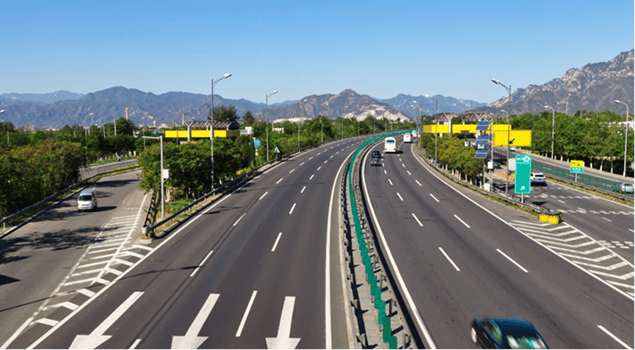
Delhi Dehradun Expressway
Table of Contents
- Loading contents...
Project at a Glance | |
Project Name | Delhi Dehradun Expressway |
Project Type | Greenfield & Brownfield |
Project Sector | Infrastructure |
Expressway Length | 210 km |
Construction Start Date | December 4, 2021 |
Construction Completion Date | February 2026 (Expected) |
Project Status | Partially operational |
Project Cost | INR 12,000 crore (Approximately USD 1.44 billion). |
Owner & Developer | National Highway Authority of India (NHAI) |
Starting Point | Akshardham (Delhi) |
Ending Point | Dehradun |
Project Overview
The Delhi Dehradun Expressway is a 210 km greenfield and brownfield expressway connecting Delhi and Dehradun. The expressway (also known as Delhi-Saharanpur-Dehradun Expressway) is a planned six-lane (expandable to eight or even twelve lanes) expressway. It is developed by the National Highway Authority of India (NHAI) under an Engineering, Procurement, and Construction (EPC) Contract model.
It will connect three states, including Delhi, Uttarakhand, and Uttar Pradesh, and reduce travel time by half. Currently, it takes 5-6 hours to travel. Upon its completion (expected to be fully operational by February 2026), the journey from Delhi to Dehradun will take only 2.5 hours.
Once operational, it is expected to reduce traffic congestion, as the expressway features a separate 32 km-long, six-lane service road for city traffic. Furthermore, the expressway is expected to carry approximately 20,000 to 30,000 vehicles per day at an average speed of 100 km/h.
Project Background
The Delhi Dehradun Expressway (also called National Highway 709 B) is an ambitious project of the National Highways Authority of India (NHAI) under the Bharatmala Pariyojana. Union Minister of Road Transport and Highways, Nitin Gadkari, first laid the foundation stone on 26 February 2021. Prime Minister Narendra Modi then laid the foundation stone again on 4 December 2021.
The project is developed on an Engineering, Procurement, and Construction (EPC) basis, utilizing cutting-edge technologies to protect sustainability. It is part of India’s extensive expressway expansion plan, just like the Delhi-Mumbai Expressway.
The expressway will relieve congestion on the Delhi NCT and further reduce traffic on the Delhi-Meerut Expressway and other connecting highways.
Delhi-Dehradun Expressway Opening Date
The under-construction (partially operational) Delhi-Dehradun Expressway is nearing completion. Developed under four phases, some segments are already operational. These include Daat Kali to Asharodi (spanning 3.5 km) and Akshardham to Khekra (spanning 31.6 km). The expressway is expected to be fully operational by February 2026.
40+ reviews
Find the Latest Infrastructure Projects In India
Gain exclusive access to our industry-leading database of Infrastructure projects with detailed project timelines and stakeholder information.
Collect Your Free Leads Here!
No credit cardUp-to-date coverage
Joined by 750+ industry professionals last month
Project Timeline
Year | Event |
February 2026 | Expected completion date for the expressway |
December 2025 | A 32 km-long stretch was opened for the trial run |
December 2021 | Prime Minister Narendra Modi laid the foundation stone for the expressway |
February 2021 | Nitin Gadkari laid the foundation stone for the expressway for the first time. |
January 2021 | Land acquisition and tender awards completed. |
February 2020 | The Central Government granted in‑principle approval. |
Delhi Dehradun Expressway Route Map

Also Read:
Delhi Dehradun Expressway Route
The Delhi Dehradun Expressway, developed by the NHAI, is a 210 km (130 miles) expressway. It starts from Akshardham (Delhi) and ends at Dehradun, connecting Delhi and Dehradun via Saharanpur in half time (2.5 hours).
Furthermore, the expressway route connects the three prime states, including Delhi, Uttarakhand, and Uttar Pradesh. It also crosses through some districts, including Baghpat, Baraut, Shamli, and Saharanpur.
The expressway features two spurs that connect nearby cities. It includes a 50.7 km long six-lane Saharanpur-Roorkee-Haridwar Expressway. It will also connect to the Char Dham Highway. And another 121 km Ambala-Shamli six-lane Expressway.
Thus, it will boost connectivity between Hill Stations and pilgrimage sites in Uttarakhand and Uttar Pradesh.
Delhi Dehradun Expressway villages
Districts Covered | Villages Covered |
Baghpat | Katha, Pali, Kashmabad, Mukarampur, Lohada, Hilwari |
Muzzafarnagar | Biral, Kamrudin Nagar, Fugana, Rajpur Chhajpur |
Shamli | Kasampur, Khanpur, Khiyawadi, Kedi |
Saharanpur | Baduli Naya Gaon, Jainpur Mushtakam, Halgoya Mushtakam, Nainsob Mushtakam, Rasoolpur Kheri Ahtmal |
Delhi Dehradun Expressway’s entry-exit points
Entry Points (Delhi to Uttar Pradesh) | Exit Points | Entry Points (Uttar Pradesh to Delhi) | Exit points | |
1 | Akshardham | Khajuri Chowk | Mandola | Mandola |
2 | Geeta Colony | Sonia Vihar | Vijay Vihar | Loni |
3 | Kailash Nagar | Vijay Vihar | 5th Pusta | Vijay Vihar |
4 | Sonia Vihar | Mandola | Usmanpur | |
5 | Vijay Vihar | Shamshan Ghat (Kailash Nagar) | ||
6 | Mandola | Geeta Colony | ||
7 | 5th Pusta | Akshardham |
Four Phases of Delhi Dehradun Expressway
The Delhi Dehradun Expressway is built in four phases. The first phase starts from Delhi and ends at the Eastern Peripheral Expressway (EPE). The second phase begins at EPE and extends to Saharanpur. The third phase goes from Saharanpur towards Rajaji National Park. The last phase runs from Rajaji National Park to Dehradun. Below is the description of each phase.
Phase I - Delhi to the Eastern Peripheral Expressway (EPE)
The first phase of the Delhi Dehradun Expressway starts from the Akshardham Temple in Delhi and heads towards the Eastern Peripheral Expressway (EPE) interchange in Baghpat, Uttar Pradesh. It is a total of 32 km long, featuring a 6.4 km aerial corridor spanning from Geeta Colony to Khajoori Khas in Delhi. The other corridor is an 11.2 km long stretch in Uttar Pradesh.
Phase I, a brownfield stretch, is reducing traffic congestion and travel times. Initially, it took one hour to travel from Delhi to Baghpat. Now, it only takes 25 to 30 minutes. It also spotlights the entry and exit points at Akshardham, Geeta Colony, and Mandola.
Phase II - EPE to Saharanpur
Phase II, a greenfield stretch, begins from the Eastern Peripheral Expressway (EPE) interchange near Baghpat and heads towards the Saharanpur Bypass (Uttar Pradesh). It is approximately a 118 km long six-lane stretch featuring seven interchanges and 60 underpasses. These interchanges and underpasses will help reduce traffic and ensure smooth connectivity through Baghpat and Shamli.
Phase III - Saharanpur to Rajaji National Park
Phase III is a 40 km long brownfield stretch. It begins at the Saharanpur Bypass (Uttar Pradesh) and ends at Ganeshpur, near the entrance to Rajaji National Park (Uttarakhand). This phase will ensure the refurbishment of the existing highways.
It focuses on pedestrian crossings and wildlife protection measures, including underpasses and eco-bridges, to minimize environmental impact in the ecologically sensitive Rajaji National Park area.
Phase IV - Rajaji National Park to Dehradun
Phase IV of the Delhi Dehradun Expressway is a 19.5 km long brownfield stretch, highlighting Asia’s longest wildlife corridor. It starts from Ganeshpur, near Rajaji National Park, and ends at Dehradun (Uttarakhand).
This phase holds Asia’s longest wildlife corridor (12 km), including a 6-meter vertical clearance for elephants and other animals, a 2.322 km twin-tube tunnel, a 340-meter single-tube Daat Kali tunnel, and a 2.12 km at-grade hill section.
By minimizing its environmental impact through eco-sensitive designs, the expressway traverses the Shivalik Hills and the Rajaji Tiger Reserve.
40+ reviews
Find the Latest Infrastructure Projects In India
Gain exclusive access to our industry-leading database of infrastructure projects with detailed project timelines and stakeholder information.
Collect Your Free Leads Here!
No credit cardUp-to-date coverage
Joined by 750+ industry professionals last month
Project Cost
The total estimated cost of constructing the Delhi-Dehradun Expressway is INR 12,000 crore (approximately USD 1.44 billion).
Project Scope
The following are the project scope of the Delhi-Dehradun Expressway
High-Speed Travel: The expressway is designed for high-speed travel, with a speed limit of 100 km/h.
Carry Asia’s Longest Wildlife Corridor: A 12 km long corridor near Rajaji National Park (Uttarakhand). It further includes six animal underpasses and two elephant underpasses.
Reduced travel time: Currently, it takes approximately 5 hours to travel from Delhi to Dehradun. Upon the expressway’s completion, it will only take 2.5 hours. It will reduce travel time by half.
Incorporation of Intelligent Traffic Management Systems (ITMS): This will enable real-time monitoring, enhance safety, and facilitate smooth travel.
Tunnels and infrastructure: It includes six entry and exit points, 113 underpasses, 76 km of service roads, 29 km of elevated highways, 5 ROBs, and 62 bus shelters.
Connectivity with other expressways: The Delhi Dehradun Expressway also connects with the NH-344, NH-58, and the Eastern Peripheral Expressway (EPE).
Ecological measures under the expressway
340-meter tunnel near Dal Kali Temple: The aim was to avoid disturbing wildlife sanctuaries.
Use of Noise Barrier Devices: The expressway has installed noise barrier devices near the forest to reduce noise pollution.
Use of Fly Ashes: The use of Fly Ashes during construction helps reuse industrial waste and protects the environment.
Sustainable water management technique: Water harvesting systems are executed along the expressway.
Packages and Contractors
Phases | Packages | Location | Contractors |
Phase I | Package 1 | Akshardham NH-9 Junction to Delhi-UP border | Gawar Construction |
Package 2 | Delhi/UP Border to EPE Junction | Ceigall India (previously awarded to Gayatri Projects) | |
Phase II | Package 1 | EPE near Khekra to Lohadda village | Raj Shyama |
Package 2 | Lohadda village to Karaunda Mahajan village | Krishna Constructions | |
Package 3 | Karaunda Mahajan village to Khyawari village | Jandu Construction India Pvt Ltd, a joint venture with Shiv Build India Pvt Ltd | |
Package 4 | Khyawari village to Latifpur village at the Saharanpur Bypass | Krishna Construction | |
Phase III | Saharanpur to Ganeshpur | Not specified | |
Phase IV | Package 1 | Ganeshpur to Mohand | Vasishta Constructions |
Package 2 | Chainage (near Mohand) to Daat Kali Tunnel | Ram Kumar Contractor – Bharat Construction India Pvt. Ltd. (JV) |
Latest News About The Delhi Dehradun Expressway
Delhi-Saharanpur-Dehradun Expressway Opens For Trial Run
The much-awaited Delhi-Dehradun Expressway Phase I, starting from Akshardham to the Eastern Peripheral Expressway (EPE) near Baghpat, has opened for trial for the general public, the Union Ministry of Road Transport and Highways (MoRTH) announced on 1 December 2025.
The NHAI Officials said that travellers will not be charged tolls for using the stretch during the one-month trial period.
According to officials, the roadway will reduce traffic congestion for travellers heading to Noida and Ghaziabad by providing a direct, high-speed connection to the cities.
The new route that has emerged will redirect multiple cars from crowded corridors, relieving pressure on other expressways and easing traffic through better segregation.
Although the Phase I stretch had been ready for at least six months, it remained inaccessible because the Prime Minister’s Office wanted the entire corridor inaugurated as a whole rather than in parts.
To increase and support transportability, NHAI is also developing new parking lots and rest facilities along the Delhi stretch between Akshardham Junction and the Uttar Pradesh border. Three such modern facilities featuring restrooms, drinking water units, solar-powered lighting, first-aid rooms, and electronic parking systems will come up near the East Delhi district magistrate's office, Gandhi Nagar market, and Geeta Colony.
Benefits
Reduced Travel Time: The expressway will halve travel time. Upon completion of the operation, it will take only 2.5 hours to travel.
Sustainability: The expressway is designed and built with a focus on prioritizing environmental considerations. It includes street tree planting, rainwater harvesting, and solar panels on elevated areas.
Protecting wildlife: The expressway features Asia’s longest 12 km elevated wildlife corridor, underpasses, noise barriers, and a 340 m tunnel, all designed to preserve wildlife and biodiversity.
Economic benefits: The expressway facilitates freight movement, reduces logistics costs, and relieves congestion.
Boosts tourism and real estate in the region: The expressway enhances tourism by providing easy access to Haridwar, Rishikesh, Mussoorie, and the Char Dham circuit, thereby boosting real estate and hospitality in adjacent regions.
Conclusion
The 210 km-long Delhi Dehradun Expressway is a transformative greenfield project that will connect the National Capital (Delhi) to Uttarakhand. The expressway is about to reduce travel time by half. Currently, it takes 5 hours to travel to Dehradun. Upon operation, the journey will take only 2.5 hours.
With partial stretches already in use and ambitious eco-conscious features, such as Asia’s longest wildlife corridor, the project is scheduled for full completion and inauguration by February 2026, thereby boosting connectivity and regional development.
Track the Latest Infrastructure Projects in India for Business Opportunities.
Subscribe to our upcoming and ongoing infrastructure projects in India to access reliable, high-quality insights on forthcoming and completed infrastructure projects across the country.
Our user-friendly platform provides essential details, timely updates, key stakeholder contact information, and business opportunities tailored for engineering companies, industry professionals, investors, and government agencies.
Start a free demo to take your business to the next level.

Leave a Comment
We love hearing from our readers and value your feedback. If you have any questions or comments about our content, feel free to leave a comment below.
We read every comment and do our best to respond to them all.